
Introduction
Slope instability and falling rocks are significant challenges in infrastructure construction, mining, transportation and hillside development. Unstable rock fragments, weathered soil and loose stones can threaten highways, railways, tunnels, industrial facilities and nearby buildings.
Two commonly used engineering solutions are active slope protection systems and passive rockfall protection systems. Both use flexible metal mesh and steel components, but they serve different purposes and operate according to different engineering principles.
An active slope protection net is generally installed directly against the slope surface and anchored to help restrain loose rock and soil. A passive rockfall protection net is usually installed between the potential rockfall source and the area requiring protection, where it intercepts falling material.
Understanding the differences between these two systems is essential for selecting suitable materials, planning installation and achieving reliable long-term performance.
This guide explains how active and passive slope protection nets work, their main components, typical applications, advantages, limitations and key considerations when purchasing a rockfall protection system.
1. What Is an Active Slope Protection Net?
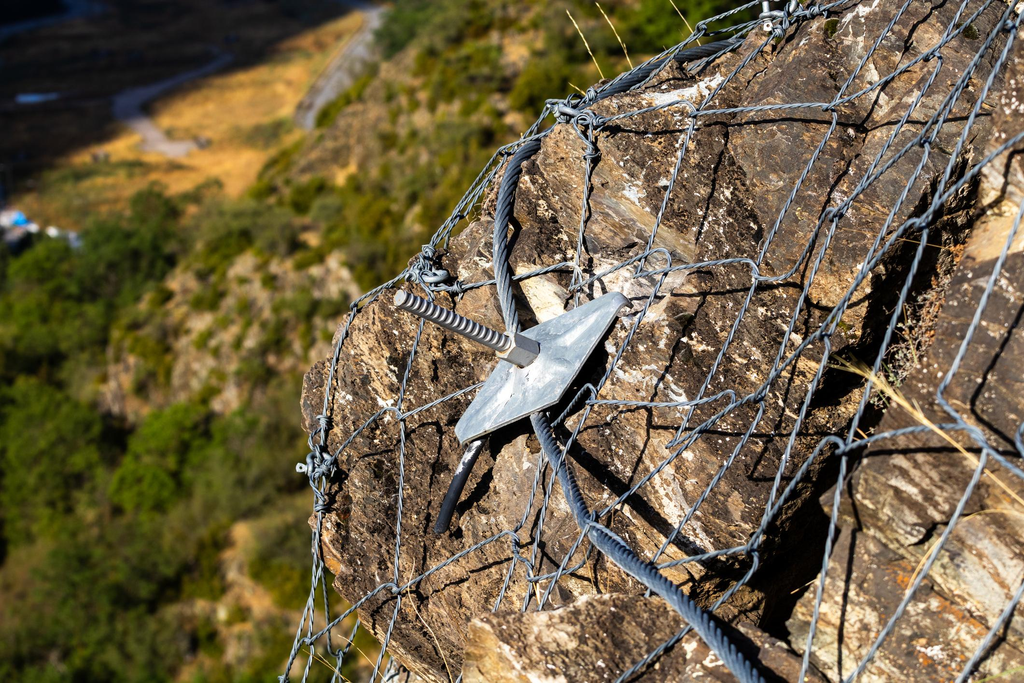
An active slope protection net, also known as an active slope stabilization mesh system, is designed to restrain unstable material on a slope. The mesh is installed directly against the rock or soil surface and secured using anchors, rock bolts, support ropes and specialized fastening components.
Depending on the system design, the mesh may be tensioned against the slope to help control the movement or detachment of loose rock fragments.
Active protection systems are commonly used on steep rock faces, weathered slopes, road cuttings, railway embankments, quarries and other areas where loose material may detach from the slope.
How Does an Active Slope Protection Net Work?
The working principle is based on surface restraint and load transfer.
First, the mesh is placed against the slope surface. Anchors and fastening components secure the system to suitable ground or rock. The mesh then helps restrain loose material and transfers loads to the designed anchoring system.
The actual performance depends on the mesh strength, anchor arrangement, ground conditions, installation quality and overall engineering design.
Active systems are not a substitute for every form of deep-seated slope stabilization. Where a slope has major structural instability or deep-seated movement, additional geotechnical measures may be required.
Main Components of an Active Slope Protection System

1. High-Tensile Steel Wire Mesh
The main facing material. Common options include steel wire rope mesh, high-tensile steel wire mesh and double-twisted hexagonal wire mesh, depending on the system requirements.

2. Anchors and Fixing Plates
These components secure the mesh to the slope and transfer loads into the supporting ground or rock. Anchor type, length and spacing must be determined by engineering requirements.

3. Support and Connection Ropes
Depending on the system, ropes reinforce the mesh, connect fixing points and help distribute loads across the protected surface.
Typical Applications of Active Slope Protection Nets
- Highway and railway rock cuttings
- Steep rock faces with loose or weathered material
- Mining and quarry slopes
- Hillside developments and construction sites
- Slopes requiring surface stabilization and erosion-control measures
- Projects combining slope protection with vegetation restoration, where the selected system permits it
Advantages of Active Slope Protection Systems
- Directly restrain loose surface material when properly designed and anchored.
- Adapt to irregular slope profiles and complex rock surfaces.
- Provide a flexible alternative to some rigid surface protection structures.
- Can be combined with suitable drainage and vegetation measures.
- Allow different mesh types and fastening configurations to be selected for project-specific conditions.
However, an active net alone does not guarantee slope stability. The slope geology, water conditions, anchor capacity and potential failure mechanism must be assessed before selecting the system.
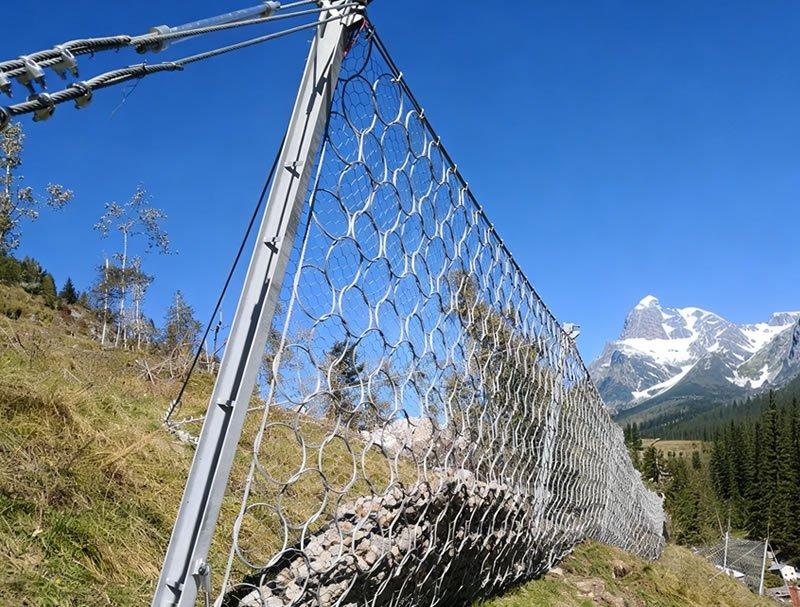
A passive rockfall protection net, also known as a passive rockfall barrier or rockfall protection fence, is designed to intercept falling rocks before they reach a protected area.
Unlike an active system, which is normally attached directly to the slope, a passive system is usually installed at a suitable location below or in front of the potential rockfall source. It creates a protective barrier between the hazard and vulnerable infrastructure.
Passive systems are widely used along highways, railways, mountain roads, tunnel entrances, mining areas and other locations exposed to falling rocks.
The system is engineered to capture falling material and dissipate impact energy through the deformation of its mesh, support ropes and energy-absorbing components.
How Does a Passive Rockfall Protection Net Work?
The working principle is based on rockfall interception and energy absorption.
When a falling rock strikes the barrier, the flexible mesh deforms and transfers impact loads through the support ropes, energy dissipators, steel posts and anchoring system. This coordinated response helps reduce the energy of the moving rock and prevents it from entering the protected area.
The system’s performance depends on factors such as the design impact energy, rock size and trajectory, barrier height, span, mesh configuration, foundation conditions and anchorage capacity.
Rockfall barriers must be selected according to an appropriate engineering assessment. A taller fence or stronger-looking mesh does not automatically mean that the system is suitable for a particular project.
Main Components of a Passive Rockfall Protection System

1. Ring Net or Steel Wire Rope Mesh
Forms the main interception surface. Depending on the tested system, it may use ring netting, cable mesh or another approved mesh configuration.

2. Steel Support Posts
Support the barrier and transfer loads into the foundation and anchoring arrangement. Post height, spacing and structural capacity are project-specific.

3. Energy Dissipation Components
Specialized brake rings or other energy-absorbing devices may extend and control the deformation of the system during impact.

4. Support Ropes, Anchors and Connectors
Connect the mesh to the posts and anchoring points. Their strength and layout must match the selected barrier system.
Typical Applications of Passive Rockfall Protection Nets
- Mountain highways and road cuttings
- Railway corridors near unstable rock slopes
- Tunnel entrances and portals
- Mining and quarry boundaries
- Industrial facilities below rocky slopes
- Reservoir banks and other infrastructure exposed to falling rocks
Advantages of Passive Rockfall Protection Systems
- Intercept falling rocks before they reach protected assets.
- Can be installed at a suitable distance from the unstable slope.
- Flexible construction can accommodate impact deformation.
- Modular components may allow damaged sections to be inspected and repaired.
- Different barrier heights and energy ratings can be specified for different hazard conditions.
A passive barrier does not necessarily stabilize the original slope. Loose rocks may continue to detach behind the barrier, so accumulated debris, impact damage, anchor conditions and remaining barrier capacity must be inspected and maintained.
3. Active vs. Passive Slope Protection Nets: Key Differences
The most important difference is the purpose of the system: active protection restrains unstable material at the slope surface, while passive protection intercepts falling material along its trajectory.


10
Detailed Comparison Table
| Comparison item | Active Slope Protection Net | Passive Rockfall Protection Net |
|---|---|---|
| Primary purpose | Restrain loose surface material | Intercept falling rocks and debris |
| Installation position | Directly against the slope | At a suitable interception location |
| Working principle | Surface restraint and load transfer | Impact interception and energy absorption |
| Main mesh types | High-tensile wire mesh, steel rope mesh, hexagonal mesh | Ring net, steel rope mesh or other tested barrier mesh |
| Main supporting components | Anchors, fixing plates, support ropes and connections | Steel posts, support ropes, anchors and energy dissipators |
| Typical applications | Unstable rock faces, weathered slopes and loose surface material | Roads, railways, tunnel entrances and assets below rockfall zones |
| Design considerations | Slope geometry, ground conditions, anchor capacity and restraint loads | Rockfall trajectory, impact energy, barrier height, span and anchorage |
| Common maintenance needs | Check mesh damage, anchors, tension and corrosion | Check impact damage, mesh deformation, posts, anchors and debris |
| Main limitation | Does not automatically solve deep-seated slope instability | Does not automatically stabilize the source slope |
The exact components and performance depend on the selected system. Some mesh products can be used in different system configurations, but their suitability must be established through the relevant engineering design and testing.
walcoom.com
+2
The Difference in One Sentence
- Active slope protection net: Helps hold unstable material against the slope.
- Passive rockfall protection net: Helps catch falling material before it reaches the protected zone.
This distinction is the starting point for choosing the correct system.
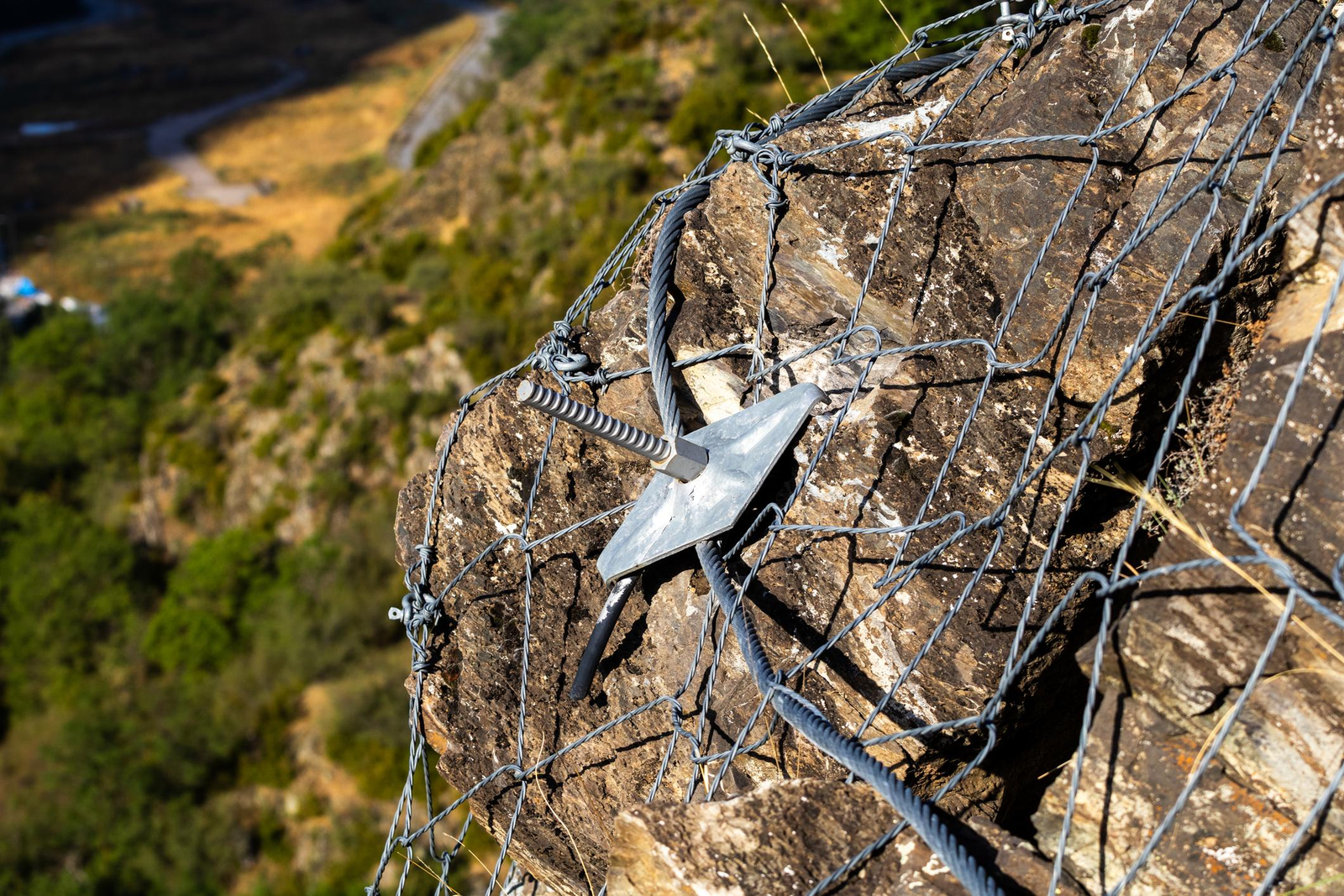
4. Active and Passive Protection: Visual Structure Comparison

Active Protection
The mesh follows the slope surface and is secured with anchors and fixing components.

Passive Protection
The barrier stands across a potential rockfall path to intercept moving rocks.
For website visitors, these two images should ideally be presented as a side-by-side comparison. Use descriptive image alt text such as:
alt="Active slope protection net anchored directly to a rocky slope"alt="Passive rockfall protection barrier with steel posts and ring mesh"
These descriptions help explain the images to users and provide relevant context for search engines.
5. Which System Should You Choose for Your Project?
Choosing between an active slope protection net and a passive rockfall barrier requires more than comparing product prices or mesh specifications. The correct solution depends on the source of the hazard, the movement of the material and the assets that need protection.

Choose an Active Slope Protection Net When:
- Loose stones or weathered material may detach from a steep slope.
- Surface restraint is required across an exposed rock face.
- The system can be safely anchored to suitable ground or rock.
- The project requires a flexible mesh facing rather than a rigid surface structure.
- The design calls for a combination of mesh, anchors, support ropes and possibly vegetation measures.
Choose a Passive Rockfall Protection Net When:
- Falling rocks may travel toward a road, railway, building or industrial facility.
- A suitable location is available to install an interception barrier.
- The design requires a specified rockfall energy absorption capacity.
- The project needs a barrier with an engineered height, span and anchoring arrangement.
- Inspection and maintenance can be performed after rockfall events.
Can Active and Passive Systems Be Used Together?
Yes. In some projects, combining the two approaches provides a more comprehensive risk-management strategy.
For example, an active mesh system may help restrain loose surface rocks on the upper slope, while a passive barrier below the slope intercepts material that still detaches or travels beyond the active system.
However, the combination should be selected only after a site-specific assessment. It is not necessary or economical to install both systems on every slope.
6. Materials and Surface Treatment
Material selection influences mechanical performance, corrosion resistance, durability and maintenance requirements. The appropriate specification depends on the environment and the design requirements of the project.

Hot-Dip Galvanized Steel
A common option for outdoor slope protection systems. The zinc coating helps protect steel components against corrosion. Coating quality and thickness should meet the relevant project specifications.

High-Tensile Steel Wire Mesh
Used in suitable active stabilization and passive interception systems. Mesh strength, wire construction, opening size and connection details must match the system design.

Steel Ring Net
Commonly used in passive rockfall barriers designed to withstand impact loads. Ring geometry, wire configuration and connection details vary by system.
For coastal areas, humid environments or locations exposed to industrial pollutants, the corrosion-protection requirements should be evaluated carefully. Stainless steel may be appropriate for certain components or applications, but it should not be assumed necessary for every system.
7. Important Technical Specifications to Consider
When requesting a quotation for an active or passive slope protection net, buyers should provide as much project information as possible.
| Specification | Active Protection | Passive Protection |
|---|---|---|
| System type | High-tensile mesh, steel rope mesh or other specified system | Ring net, cable mesh or specified barrier system |
| Mesh opening | Based on the required restraint and retention function | Based on the tested system and target rock sizes |
| Wire or rope diameter | Specified by the selected system | Specified by the selected barrier system |
| Protection dimensions | Slope area, length, width and surface geometry | Barrier height, total length and individual span |
| Anchoring arrangement | Anchor type, spacing, length and ground capacity | Foundation, post anchorage and support-rope anchors |
| Performance requirements | Restraint loads, mesh capacity and anchor design | Required impact energy absorption and barrier performance |
| Surface treatment | Galvanizing or another specified protection system | Galvanizing or another specified protection system |
| Installation conditions | Slope angle, geology, access and drainage | Rockfall trajectory, installation location and foundation conditions |
Important: There is no single mesh opening, wire diameter, anchor spacing or barrier height suitable for every project. Final specifications should follow the applicable engineering design and relevant testing or approval requirements.
For passive barriers, energy absorption is often expressed in kilojoules (kJ). A higher rating is not automatically better for every project; the required rating must be determined from the expected rockfall conditions and applicable design criteria.
8. Installation and Quality Control
Both active and passive systems depend on proper installation. Even high-quality mesh may fail to perform as intended if the anchors, connections or supporting structures are unsuitable.
Active Slope Protection Installation

A typical installation process may include:
- Site investigation and assessment of the slope’s geological conditions.
- Removal of loose material where required by the engineering plan.
- Preparation of the slope surface and installation of anchors.
- Placement of the specified mesh and support ropes.
- Connection, fastening and tensioning according to the system design.
- Inspection of anchors, connections, mesh coverage and drainage conditions.
The exact sequence and anchoring requirements vary according to the selected system and site conditions.
Passive Rockfall Barrier Installation

A typical installation process may include:
- Assessment of rockfall trajectories and the proposed barrier location.
- Verification of barrier height, span, energy rating and foundation requirements.
- Installation of foundations, posts and anchoring components.
- Connection of support ropes, mesh panels and energy-dissipating components.
- Verification of the completed system against the approved drawings.
- Inspection, documentation and maintenance planning.
Installation should be carried out by qualified personnel in accordance with the system manufacturer’s instructions and the project engineer’s requirements.
What Should Buyers Check Before Ordering?
- Material grade and mesh construction
- Wire or rope diameter and mesh opening
- Galvanizing or other corrosion-protection specifications
- Anchor, connector and support-component requirements
- System drawings and installation instructions
- Relevant test reports and compliance documentation
- Packaging, transport and delivery requirements
For passive barriers, buyers should also verify the stated energy rating and the supporting test documentation for the exact system configuration being offered.
9. Frequently Asked Questions About Active and Passive Slope Protection Nets
Q1: What is the main difference between active and passive slope protection nets?
The main difference is their working principle. Active slope protection nets are installed against the slope to help restrain loose rocks and surface material. Passive rockfall protection nets are installed along potential rockfall paths to intercept falling rocks and absorb impact energy.
Q2: Is a passive rockfall barrier the same as a rockfall fence?
The terms are often used interchangeably in commercial descriptions. However, not all rockfall fences have the same design or performance. A properly specified passive barrier should have an appropriate structural configuration and verified performance for its intended application.
Q3: Which mesh is commonly used for active slope protection?
Common options include high-tensile steel wire mesh, steel wire rope mesh and double-twisted hexagonal wire mesh. The appropriate type depends on the required restraint function, slope conditions, anchoring design and project specifications.
Q4: Which mesh is commonly used for passive rockfall protection?
Passive barriers may use steel ring nets, wire rope mesh or other engineered mesh configurations. The selection depends on the required energy absorption capacity, expected rock size, barrier height and tested system design.
Q5: Can active slope protection nets prevent landslides?
Active mesh systems can help restrain loose surface material and certain localized rockfall hazards. However, they cannot automatically prevent deep-seated landslides or major slope movements. These conditions require geotechnical investigation and an appropriate stabilization design.
Q6: How is the energy absorption capacity of a passive rockfall barrier determined?
It is established through the relevant system design, engineering assessment and applicable testing or approval procedures. Buyers should verify the documented energy rating and ensure it applies to the proposed system configuration.
Q7: Are active and passive slope protection nets suitable for highway projects?
Yes. Active systems may be used on unstable cut slopes, while passive barriers may be installed where falling rocks could reach the roadway. Some projects use both, depending on the identified hazards and engineering assessment.
Q8: What information is needed to request a quotation?
Useful information includes the required system type, project location, dimensions, mesh opening, material and surface treatment, expected environmental conditions, performance requirements and available drawings. For passive barriers, include the required energy rating, height and span whenever these have been established by the project engineer.
Q9: How can buyers compare different slope protection net suppliers?
Compare the technical specifications, material quality, corrosion protection, manufacturing consistency, test documentation, component compatibility and ability to meet project requirements. Price should be assessed alongside the complete system specification rather than mesh price alone.
10. Conclusion: Choose the Right Slope Protection Solution
Active and passive slope protection nets serve complementary but different roles in rockfall risk management.
Active slope protection focuses on restraining loose material directly against the slope. Passive rockfall protection focuses on intercepting falling material before it reaches roads, buildings and other protected areas.
Before selecting a product, evaluate the slope conditions, expected failure mechanism, required protection performance, anchoring conditions and applicable engineering standards. The right choice is the system that matches the actual hazard and can be installed, inspected and maintained correctly.
For construction contractors, engineering companies, distributors and infrastructure project buyers, understanding these differences helps improve product selection, quotation accuracy and project planning.
Looking for Slope Protection Mesh for Your Project?

At Hebei Qianxin Wire Mesh Manufacturing Co., Ltd., we specialize in wire mesh manufacturing and metal mesh processing. We can discuss project requirements for suitable wire mesh products, including material, mesh opening, dimensions and surface treatment, subject to product availability and technical requirements.
Whether you are sourcing mesh for slope stabilization, rockfall protection or infrastructure construction, providing project drawings and specifications is the best way to identify suitable products.
Contact our team to discuss your requirements and request a quotation.
- Email: jia17331885280@gmail.com
- WhatsApp: +86 18866621490
For engineering projects, please confirm the required system design, component compatibility, load capacity and applicable certifications with the responsible project engineer before ordering.